
Tracking your body composition can offer more insight than checking your weight alone. If you are working on fitness goals, monitoring changes in muscle mass, or trying to understand body fat trends, a smart body composition scale may help you collect useful information at home.
Hume Health offers the Hume Body Pod, a connected body composition device designed to estimate multiple body metrics. But how accurate are its readings, and can you rely on them to monitor your progress?
In this guide, we explain how Hume Health body composition tracking works, what can influence its readings, how to interpret the results, and what to consider before buying.
If you want to understand the brand and its products more broadly, explore our Hume Health Review and Buying Guide before deciding whether the device fits your needs.
Hume Health Coupon Code: Save on Your Hume Body Pod
If you are considering purchasing a Hume Body Pod, check whether our Hume Health coupon code AFFILZA can help you save on your order.

20% Off (Sitewide) EXCLUSIVE! Coupon Code
Use code AFFILZA at checkout to claim 20% off, provided the promotion is active and your selected product qualifies. Enter the code before completing your purchase and check that the discount appears in the final order total.
For current product specifications, pricing, and availability, visit the Hume Health store.
What Is Hume Health Body Composition Tracking
Body composition refers to the different components that make up your body, including fat mass, lean tissue, and body water. Body weight alone cannot explain how these components may change over time.
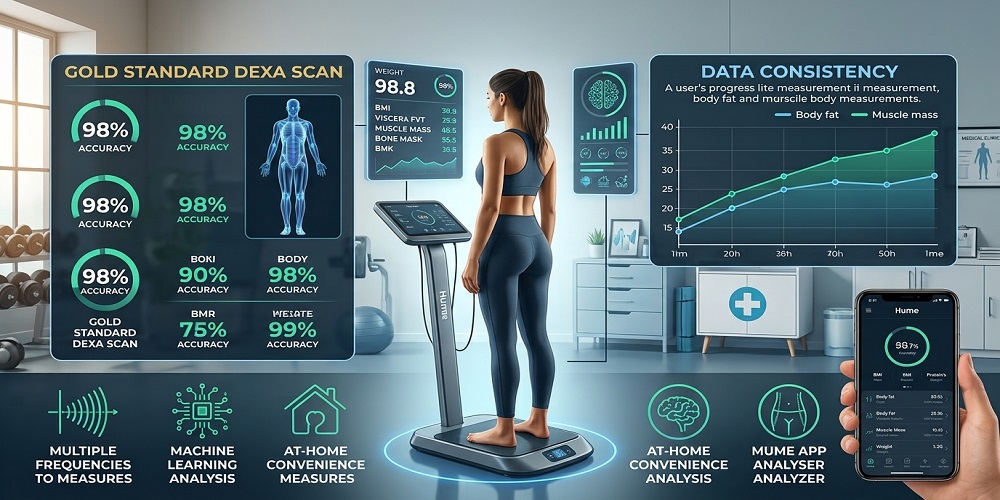
Hume Health's Body Pod is designed to provide body composition estimates alongside weight measurements. According to the manufacturer's product information, the device uses bioelectrical impedance analysis (BIA), multiple frequencies, and sensors that make contact through the hands and feet.
These measurements are processed to estimate body composition metrics. The resulting information can help users observe trends, but the readings are estimates rather than direct measurements of every tissue in the body.
Understanding this distinction is essential when evaluating the accuracy of any consumer body composition device.
How Does Hume Health Measure Body Composition?
1. Bioelectrical Impedance Analysis
Bioelectrical impedance analysis, commonly known as BIA, is a method used by body composition devices to estimate aspects of body composition.
The technology sends a very small electrical current through the body and measures how the body responds to it. Differences in electrical impedance, together with information such as height, age, and other model inputs, can be used to estimate body water and body composition.
The resulting measurements depend on the device's sensors, algorithms, and assumptions about the relationship between electrical impedance and body tissues.
2. Multiple-Frequency Measurements
Hume Health describes the Body Pod as using eight frequencies to collect information about body composition. Its technology is intended to assess different aspects of electrical impedance that can contribute to estimates of body water and other metrics.
Using multiple frequencies may provide more information than a simpler measurement system. However, additional frequencies do not automatically guarantee that every reported metric is accurate for every person.
The performance of a device must be assessed using appropriate validation evidence and the specific measurements being evaluated.
3. Hand and Foot Sensors
[IMAGE 3: Close-up illustration of a smart body composition scale with hand and foot contact points]
The Hume Body Pod uses contact points through the hands and feet to collect measurements from more of the body than a conventional foot-to-foot scale.
This approach is intended to provide segmental information about different body regions. However, the accuracy of the resulting estimates still depends on measurement conditions, the calculation models, and how well those models apply to the individual user.
For the manufacturer's description of its measurement technology, consult the official Hume Body Pod science and technology information.
How Accurate Is Hume Health for Body Composition Tracking?
The short answer is that Hume Health's readings may be useful for tracking trends, but they should not be treated as perfectly precise measurements of body fat or muscle mass.
Hume Health advertises its Body Pod as having a high level of agreement with DEXA-based measurements. Its product information describes an independent validation claim involving comparison with DEXA. These are manufacturer-reported claims, and the exact meaning of the reported accuracy figure depends on the study design, metric measured, sample population, and statistical method used.
For example, a high correlation between two measurement methods does not necessarily mean that their readings will match closely for every individual. Correlation shows how measurements relate to one another; agreement describes how closely their actual values correspond.
Research on consumer BIA devices has also found that the agreement with reference methods can vary by device and measurement arrangement. A study comparing consumer devices with DXA and MRI reported differences in how closely individual body composition estimates matched the reference methods.
This means the most useful question is not simply whether a scale is accurate. It is whether its measurements are sufficiently consistent and appropriate for the purpose for which you want to use them.
You can read the manufacturer's information at Hume Health's Body Pod science page and explore the research on consumer BIA accuracy in the sources linked at the end of this article.
What Can Affect Hume Health Measurement Accuracy?
Even when you use the same device repeatedly, your readings may vary. Several factors can influence body composition estimates.
1. Hydration Levels
Changes in hydration can influence electrical impedance and the estimated distribution of body water and lean tissue.
If you take one measurement after a normal day and another after heavy exercise or significant fluid loss, the results may not be directly comparable.
2. Recent Exercise
Exercise can temporarily affect fluid distribution and other conditions that influence measurements. For more consistent comparisons, follow the manufacturer's guidance about when and how to measure.
3. Meals and Fluid Intake
Eating and drinking can change body weight and may affect measurement conditions. Taking readings under similar circumstances can make it easier to compare trends.
4. Sensor Contact and Positioning
Contact with the measurement electrodes matters. Follow the instructions for positioning your hands and feet, and make sure the device is used as directed.
5. Individual Body Characteristics
Prediction equations may not perform equally well for every individual. The manufacturer's technical FAQ notes that people with certain body compositions, significant edema, or major deviations from standard body proportions may experience greater uncertainty in estimates.
If you have a medical condition that affects fluid balance, consult a qualified healthcare professional before relying on consumer body composition measurements for health decisions.
How to Get More Consistent Hume Health Readings
[IMAGE 4: Person using a smart body composition scale at home in a bright, uncluttered room]
You cannot eliminate every source of measurement error, but you can make your tracking routine more consistent.
-
Measure at a similar time: A morning measurement may help reduce variation from daily activities, provided you follow the manufacturer's instructions.
-
Use the same location: Keep the device on a stable, suitable surface.
-
Follow the instructions: Use the correct hand and foot positions and the recommended measurement procedure.
-
Keep conditions similar: Avoid comparing readings taken under very different hydration, exercise, or meal conditions.
-
Track changes over time: Focus on patterns across multiple readings rather than a single result.
-
Record other progress indicators: Consider strength, fitness performance, clothing fit, and other relevant measures alongside body composition.
Consistency makes your data easier to interpret, but it does not guarantee that every estimate matches a clinical reference method.
Is Hume Health More Accurate Than a Regular Smart Scale?
The answer depends on which devices and measurements you compare.
The Hume Body Pod uses hand and foot contact points and multiple-frequency measurements, according to the manufacturer. Many conventional smart scales use a simpler foot-to-foot arrangement. Different measurement designs can affect the information collected, but design differences alone do not prove that one device is more accurate for every metric.
When comparing the Hume Body Pod with another scale, look for:
-
Independent validation data for the specific device.
-
The body composition metrics included in the validation.
-
The number and characteristics of people studied.
-
Agreement with a reference method, not just correlation.
-
Information about measurement limitations and repeatability.
Hume Health vs. DEXA: What Is the Difference?
DEXA, also known as DXA, is an imaging-based method used to assess body composition. It is commonly used as a reference method in body composition research.
Hume Health's Body Pod is designed for convenient measurements at home, using electrical impedance and predictive calculations. DEXA uses a different measurement approach, so results from the two methods may not be identical.
The key differences include:
-
Measurement method: The Body Pod uses BIA, while DEXA uses X-ray-based imaging.
-
Convenience: A home scale is designed for repeated use without visiting a scanning facility.
-
Interpretation: Both methods have limitations, and results depend on the metric and circumstances.
-
Purpose: A consumer scale is suited to routine monitoring, while DEXA may be used when a more formal body composition assessment is needed.
Neither method should be assumed to provide an error-free result in every situation.
For more detail, see our Hume Body Pod vs. DEXA scan comparison guide.
Can You Trust Hume Health for Tracking Fat Loss and Muscle Gain?
Hume Health measurements may help you monitor changes over time, particularly when you use the device consistently. However, an individual reading should not be treated as definitive proof that you have lost fat or gained muscle.
Body weight and body composition can fluctuate for several reasons, including changes in body water. A short-term change in an estimated metric may not represent an equivalent change in actual tissue.
To evaluate progress, look at several readings over time and combine them with other indicators relevant to your goals. If you need clinically reliable information for a medical decision, ask a qualified healthcare professional about an appropriate assessment.
For more information about the device itself, visit our Hume Body Pod review, where we discuss its features, potential benefits, and limitations.
Is Hume Health Worth Buying for Body Composition Tracking?
Whether Hume Health is worth buying depends on what you expect from a home tracking device.
It may be worth considering if you want to monitor estimated body composition over time, prefer a connected tracking experience, and understand the limitations of consumer measurements.
However, you may not need a specialised body composition scale if your primary goal is simply to monitor weight. Before buying, compare the current price, app requirements, supported measurements, warranty, and any subscription costs.
You should also review the evidence supporting any accuracy claims and confirm that the device's features suit your needs.
For a wider overview of the brand, visit our Hume Health Review and Buying Guide. If you decide to purchase, check the Hume Health store and review available offers before checkout.
Final Verdict: How Reliable Is Hume Health?
Hume Health's Body Pod offers a home-based approach to estimating body composition, using BIA technology and a connected tracking experience. These features may be useful for observing trends, provided the measurements are taken consistently and interpreted carefully.
The manufacturer's accuracy claims should be considered alongside the specific validation evidence, the metrics tested, and the limitations of consumer body composition measurements. A high correlation with a reference method does not guarantee that every reading will match that method for every user.
If your goal is everyday fitness tracking, consistent measurements over time may provide useful context. If you need a clinically reliable assessment, consult a qualified healthcare professional about appropriate testing.
Before purchasing, review the product's specifications, limitations, and current pricing. You can also check whether coupon code AFFILZA is valid for your order, subject to the offer's current terms.
Frequently Asked Questions
1. How accurate is Hume Health for body composition tracking?
Its readings are estimates, and their accuracy depends on the metric, measurement conditions, and validation evidence. They may be useful for monitoring trends but should not be treated as perfectly precise measurements.
2. Does Hume Health use BIA technology?
Yes. The manufacturer describes the Hume Body Pod as using bioelectrical impedance analysis, including multiple-frequency measurements and hand and foot contact points.
3. Can hydration affect Hume Health readings?
Yes. Changes in hydration can influence impedance and estimated body composition, so it helps to compare readings taken under similar conditions.
4. Is Hume Health as accurate as DEXA?
The manufacturer reports validation comparisons with DEXA, but the meaning of any accuracy figure depends on the study and metric assessed. A consumer BIA device and DEXA use different measurement methods and may produce different results.
5. Should I use Hume Health to monitor muscle gain?
You can use its estimates as one indicator of progress, but do not rely on a single reading. Review trends over time and consider other indicators, such as strength and exercise performance.