
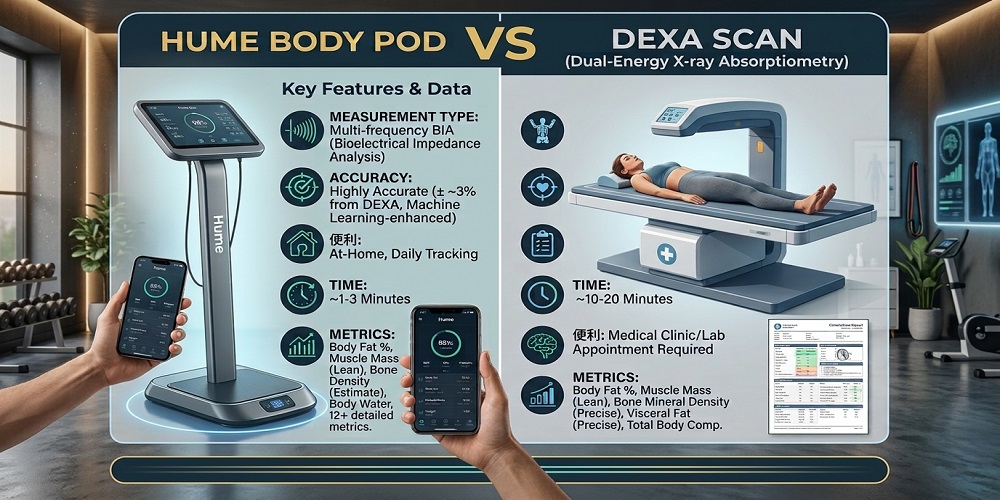
Understanding your body composition can help you track changes beyond body weight. Whether you're working toward fat loss, building muscle, or monitoring your fitness progress, choosing an appropriate measurement method can make a difference in how you interpret your results.
Two options you may encounter are the Hume Body Pod and a DEXA scan. The Hume Body Pod is an at-home body composition device that uses bioelectrical impedance analysis (BIA), while DEXA uses low-dose X-ray technology to assess body composition or bone density, depending on the type of scan performed.
But which option is right for your needs? This guide compares Hume Body Pod vs. DEXA scan, including their measurement methods, accuracy claims, convenience, limitations, and costs.
If you're new to the brand, read our Hume Health Review and Buying Guide for a broader overview of the products and features to consider before buying.
Hume Health Coupon Code: Save on Your Hume Body Pod
If you're considering purchasing a Hume Body Pod for at-home body composition tracking, check whether our Hume Health coupon code AFFILZA can help you save.

20% Off (Sitewide) EXCLUSIVE! Coupon Code
Use code AFFILZA at checkout to claim 20% off, provided the promotion is active and your selected product qualifies. Enter the code before completing your purchase and confirm that the discount appears in your order total.
For current product details, pricing, and availability, visit the Hume Health store.
What Is the Hume Body Pod?
The Hume Body Pod is an at-home body composition tracking device designed to provide estimates of body weight and additional body metrics.
According to the manufacturer, the device uses multi-frequency BIA technology and hand-and-foot contact points to collect electrical impedance measurements. These measurements are processed using calculations to estimate aspects of body composition.
The main appeal is convenience. Users can take measurements at home and review their results through a connected digital experience, subject to the product's current features and app requirements.
However, BIA does not directly image body fat or muscle tissue. Its results are estimates, and their accuracy depends on the measurement method, prediction models, and individual circumstances.
For the manufacturer's description of the technology, see the official Hume Body Pod science page.
What Is a DEXA Scan?
DEXA, also written as DXA, stands for dual-energy X-ray absorptiometry. It uses two X-ray energy levels to assess how tissues absorb radiation differently.
There is an important distinction between a standard bone-density scan and a whole-body composition scan. A clinical DEXA scan is commonly used to assess bone mineral density, particularly when evaluating conditions such as osteoporosis. A whole-body DEXA assessment can also estimate fat mass, lean soft tissue, and bone mineral content.
DEXA is widely used as a reference method in body composition research, but it is not error-free. Results may be affected by positioning, hydration, equipment, and analysis procedures.
For more information about clinical DEXA, consult RadiologyInfo's DEXA scan guide.
Hume Body Pod vs. DEXA Scan: Key Differences
The most important difference is how the two methods collect information. Hume Body Pod uses electrical impedance and prediction equations, while DEXA uses X-ray attenuation to estimate tissue composition.
| Comparison | Hume Body Pod | DEXA body composition scan |
|---|---|---|
| Measurement method | Bioelectrical impedance analysis | Dual-energy X-ray absorptiometry |
| Where it's used | Designed for at-home tracking | Typically performed at a clinic or scanning facility |
| Body fat | Provides an estimate | Estimates fat mass and body fat percentage |
| Lean mass | Provides an estimate | Estimates lean soft tissue |
| Bone information | Check the manufacturer's specific metric definitions | Measures bone mineral content; dedicated bone-density scans assess bone mineral density |
| Convenience | Can be used repeatedly at home | Requires access to a scanning facility |
| Radiation | Does not use X-rays | Uses a low dose of ionizing radiation |
| Main consideration | Results can vary with measurement conditions and prediction models | Results can vary with positioning, hydration, equipment, and analysis |
The comparison depends on the specific Hume product features and the type of DEXA scan being performed. Not every DEXA appointment includes a whole-body body composition assessment.
Which Method Is More Accurate?
Accuracy is one of the biggest questions when comparing the Hume Body Pod with DEXA.
Hume Health advertises a 98% correlation with DEXA for selected body composition measures, including fat-free mass and body fat percentage. This is a manufacturer-reported claim, not a guarantee that every reading will match a DEXA result. See the manufacturer's Hume Body Pod science page for its explanation of the validation claim.
Correlation and agreement are different concepts. Two methods can show a strong relationship across a group of people while still producing meaningfully different readings for an individual.
When assessing accuracy, look for independent validation data that explains:
-
Which measurements were tested.
-
How many people participated.
-
What population was studied.
-
How the device was compared with the reference method.
-
Whether the reported result describes correlation, average error, or agreement within a specified range.
DEXA is commonly used as a reference method in body composition research, but it also has limitations. The results depend on the scan protocol, positioning, hydration, and analysis process.
Practical takeaway: Hume Body Pod may be convenient for monitoring trends at home. DEXA may be more appropriate when you need a formal body composition assessment, depending on the purpose and the service offered. Neither method should be assumed to produce a perfectly exact result in every situation.
For a closer look at BIA measurement limitations, read our How Accurate Is Hume Health for Body Composition Tracking? guide.
Hume Body Pod vs. DEXA for Body Fat Measurement
Body fat percentage is a common metric for people tracking fitness progress, but it is important to understand how it is obtained.
The Hume Body Pod estimates body fat using electrical impedance measurements and a calculation model. Its readings may change with hydration, recent exercise, meals, and other measurement conditions.
A whole-body DEXA scan uses X-ray information to estimate fat mass and other tissue compartments. Although it is often used as a reference in research, its results can also be influenced by factors such as positioning, hydration, and the scan and analysis protocol.
If you are comparing results from both methods, avoid assuming that a difference automatically means one device is broken or that your body composition changed. The methods work differently, so their outputs may not match exactly.
For routine home tracking, consistency is important. If you use the Hume Body Pod, follow its instructions and compare readings taken under similar conditions.
Hume Body Pod vs. DEXA for Muscle Mass
Muscle-related measurements require careful interpretation because body composition devices may estimate different things under labels such as muscle mass, lean mass, or fat-free mass.
These terms are not interchangeable. Lean mass can include water, organs, connective tissue, and other non-fat components, while skeletal muscle refers to a more specific tissue category.
The Hume Body Pod provides estimates based on its measurement technology and algorithms. DEXA can estimate lean soft tissue, but this is not a direct measurement of every individual muscle.
If your goal is to monitor muscle gain, combine body composition readings with other indicators, such as strength progression, training performance, and consistent measurements over time. A single reading is not enough to confirm that muscle tissue has increased.
Cost and Convenience: Which Is Easier to Use?
Cost varies by region, retailer, clinic, and service. The Hume Body Pod involves an upfront purchase, while DEXA usually requires booking and paying for a scan at a suitable facility. Repeated scans may add to the overall expense.
Before making a decision, compare the current device price with the cost of the DEXA services available to you.
Hume Body Pod may suit you if:
-
You want to measure body composition at home.
-
You prefer frequent tracking without booking a scan.
-
You are comfortable interpreting estimated readings.
-
You want a digital record of changes over time.
DEXA may suit you if:
-
You want a formal body composition assessment.
-
You need measurements from a clinical or research setting.
-
A healthcare professional or qualified specialist recommends the scan for your particular purpose.
-
You want a reference measurement to compare with other assessments, with the understanding that methods may still differ.
If your goal is to assess bone health or osteoporosis risk, consult a healthcare professional about an appropriate clinical bone-density test. A consumer body composition scale is not a substitute for diagnostic testing.
Can You Compare Hume Body Pod Results With DEXA Results?
You can compare results for context, but you should not expect every metric to match.
For a more useful comparison:
-
Check that the measurements refer to the same metric, such as body fat percentage rather than fat mass.
-
Review the date and conditions of each measurement.
-
Follow the device instructions and any preparation guidance from the scanning facility.
-
Avoid interpreting small differences as definite changes in body tissue.
-
Ask a qualified professional to interpret results if they will influence a medical decision.
Even when both methods are used correctly, differences may arise from their measurement technologies and calculation approaches.
How to Track Body Composition More Consistently at Home
[IMAGE 5: Smart scale and smartphone in a simple home fitness space]
If you choose the Hume Body Pod for routine tracking, a consistent measurement process can make your results easier to interpret.
-
Use the device on a stable surface.
-
Follow the manufacturer's instructions for hand and foot placement.
-
Measure at a similar time of day.
-
Keep conditions as similar as practical.
-
Review patterns across several weeks instead of focusing on one reading.
-
Combine measurements with relevant fitness indicators, such as strength and training performance.
These habits can help reduce avoidable variation, but they cannot eliminate measurement error or guarantee agreement with DEXA.
Is the Hume Body Pod a Replacement for DEXA?
No consumer body composition scale should be treated as a universal replacement for DEXA.
The Hume Body Pod is designed for convenient home measurements and ongoing tracking. DEXA offers a different measurement approach and may be used for clinical bone-density assessment or whole-body composition analysis, depending on the scan.
The right choice depends on your purpose. For general fitness tracking, an at-home device may offer convenience. For a clinical question, follow the advice of a qualified healthcare professional and use the appropriate assessment.
If you are still deciding whether the Hume device fits your routine, read our Hume Body Pod review for a closer look at its features, potential benefits, and limitations.
Final Verdict: Hume Body Pod vs. DEXA Scan
Hume Body Pod and DEXA offer different approaches to understanding body composition. Hume Body Pod is designed for convenient at-home tracking using BIA technology, while DEXA uses X-ray measurements and is commonly used in clinical bone-density assessment and body composition research.
Hume Health's advertised accuracy claims should be considered in the context of the specific metrics and validation methods used. A strong correlation does not mean every reading will be identical to a DEXA result.
If your priority is convenient, repeated home tracking, the Hume Body Pod may be worth considering. If you need a formal assessment for a medical or specialist purpose, discuss the appropriate scan with a healthcare professional.
Before purchasing, compare the device's current price, features, app requirements, and warranty. You can also visit the Hume Health store and check whether coupon code AFFILZA is eligible for the advertised 20% discount.
Frequently Asked Questions
1. Is Hume Body Pod as accurate as a DEXA scan?
Hume Health reports high correlation with DEXA for selected body composition measures. Correlation is not the same as exact agreement, so individual readings may differ between the methods.
2. Does DEXA measure body fat and muscle mass?
A whole-body DEXA scan can estimate fat mass, lean soft tissue, and bone mineral content. A standard bone-density scan may focus on specific areas such as the hip and spine.
3. Is the Hume Body Pod better for everyday tracking?
It may be more convenient for repeated measurements at home. Its usefulness depends on your goals and whether you understand that body composition results are estimates.
4. Does a DEXA scan use radiation?
Yes. DEXA uses a low dose of ionizing X-ray radiation. Ask your healthcare provider or scanning facility about suitability if you have specific concerns.
5. Should I get a DEXA scan instead of buying a Hume Body Pod?
That depends on why you need the measurements. For everyday fitness tracking, a home device may be convenient. For bone-health assessment or another clinical purpose, seek professional advice about the appropriate test.